Showing posts with label eternal life. Show all posts

Sunday, August 1, 2010

Peridot - Giving Plenty

Peridot is the birthstone for the month of August. Peridot is an ancient and yet currently very popular gemstone. It is so old that it can be found even in Egyptian jewelry from the early second millennium BC. The stones used in those days came from an occurrence on a little volcanic island in the Red Sea, about 70 km off the Egyptian coast, which was rediscovered only around 1900 and has been completely exploited since. Peridot, however, is also a very modern stone, for only a few years ago Peridot occurrences were discovered in the Kashmir region, and the stones from there show a unique beauty of color and transparency, so that the image of the stone, which was somewhat dulled over the ages, has received an efficient re-polishing.

Peridot is one of the few gemstones which exist only in one color and yet the gemstone is actually known under three names: Peridot, Chrysolite (and derived from the Greek word “goldstone”) and Olivin, because Peridot is the gemstone variety of the Olivin mineral. In the gemstone trade it is generally called Peridot, a name derived from the Greek “peridona”, meaning something like “giving plenty”.

When I think on Peridot I'm reminded of some things about Jesus. Peridot exists in only one color and yet is known by three names. This reminds of the Holy Trinity (Father, Son, and Holy Spirit) that we believers know as One God. The root of Peridot's name "giving plenty" and color of yellow/gold and green reminds me of what Jesus said in John 10:10, "The thief comes only to steal and kill and destroy; I came that they may have life, and have it abundantly"NASB.
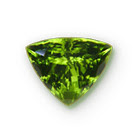
"Giving plenty" makes me think of that word "abundantly". The yellow/gold of the color makes me think of blessings (like gold, or riches), and green obviously makes me think of life itself...everlasting life which He purchased for us at Calvary with His Life and Blood.....now that's giving plenty!

NEXT POST: *The Gems of Exodus and Revelation - Chrysolite

*The Gems of Exodus and Revelation are presented in twelve monthly installments and will explore the similarities between the stones in the ephod (breastplate) of Aaron and the stones of the New Jerusalem, and their relation to Jesus.

Saturday, May 1, 2010

Emerald and Life

It's notable that the exact identity of a few stones mentioned in Exodus 28 and Revelation 21 are uncertain and differ from translation to translation. Since many of the stones are now contemporary birthstones, I will highlight them in the months in which they correspond, not necessarily in the order they are mentioned in scripture. It's also notable that the number 12 (the number of perfection in government, and completion) is a key theme throughout these particular posts.


Emerald is the birthstone for the month of May. The name "emerald" comes from the Greek 'smaragdos' via the Old French 'esmeralde', and really just means 'green gemstone'.

Green is the color of life and springtime that brings new life and new opportunities.
The lively luminosity of its color makes the emerald a unique gemstone. However, really good quality is fairly rare, with inclusions often marring the evenness of the color – signs of the turbulent genesis which has characterized this gemstone. Fine inclusions, however, do not by any means diminish the high regard in which it is held. On the contrary: even with inclusions, an emerald in a deep, lively green still has a much higher value than an almost flawless emerald whose color is paler. Affectionately, and rather poetically, specialists call the numerous crystal inclusions, cracks or fissures which are typical of this gemstone 'jardin'. They regard the tender little green plants in the emerald garden as features of the identity of a gem which has grown naturally.

When I think of emerald having the color of life and yet contain inclusions or imperfections within it, I think of what Jesus said in John 16:33 in which He states: "I have told you these things, so that in me you may have peace. In this world you will have trouble. But take heart! I have overcome the world." I think of these words because when we accept Jesus Christ as our Savior we gain life and life eternal. I think we'd agree that is a valuable thing. But just because we gain life and the security that a life in Christ brings, it doesn't mean that life won't come without troubles (i.e. imperfections, inclusions) that can make us want to discount it's value. You read earlier that "Fine inclusions, however, do not by any means diminish the high regard in which it (emerald) is held". Our life with Jesus was so important and valuable to Him that He was willing to suffer and die for us rather than live without us. But it didn't end there. After His resurrection and ascension, He now prepares a place for us to spend eternal life with Him. He conquered sin and death. He overcame the world!
Yes, life has troubles just like emeralds have imperfections, but the value of both life and emeralds is not diminished because of them. Instead, troubles in life and imperfections in emeralds become markers of what has been overcome to bring victory and beauty.

NEXT POST: **The Gems of Exodus and Revelation - Emerald

**The Gems of Exodus and Revelation are presented in twelve monthly installments and will explore the similarities between the stones in the ephod (breastplate) of Aaron and the stones of the New Jerusalem, and their relation to Jesus

Friday, May 1, 2009

Pearls and What's At The Core

The Pearl
Pearls are among the oldest and most universal of all gems. They are the oldest jewels known to man, and the only gem made by a living animal. The oldest surviving pearl necklace is nearly 2000 years old and was found in the sarcophagus of a Persian Princess. Pearls were worn in civilized Middle East and Asian societies as early as 3500 BC., and continued to grow in popularity during Roman times when pearl fever reached its peak. Pearls found a place in Julius Caesar's heart, and Cleopatra dissolved a pearl in wine and drank it to prove her love to Marc (Antony) Antonius. The early 1900s saw trade affected by a supply shortage and the appearance of cultured pearls on the market. Cultured pearls were not accepted immediately; it took several years for consumers and the industry to accept this new kind of pearl.

Pearls, and I'm talking about natural pearls here, exhibit some weight. Natural pearls are ‘organic’ gems, i.e. gems created by a living creature. NACRE (pronounced na-cur and the same substance that lines the inside of the oyster shell) produced by the oyster begins to cover whatever foreign object enters into the mussel's environment in an effort to make it smooth and less irritating to the sensitive tissue of the mussel. This process continues over many years to produce a pearl of PURE NACRE. The larger the pearl, the more dense it becomes. This layer of nacre can be affected by any act of nature such as predator attack, disease, disturbances in the ocean floor such as earthquakes, etc. and can affect the creation of the pearl. Lustre and surface imperfections play a huge role in the 'grading' of a pearl, and are directly affected by such attacks, disease, and other factors that might cause stress to the mussel.
As with all gems, the more perfect, the more valuable.

In
Matthew 13:45-46 Jesus tells the disciples (and us) what the Kingdom of Heaven is like.

"45Again, the kingdom of heaven is like a merchant looking for fine pearls. 46When he found one of great value, he went away and sold everything he had and bought it”. (NIV)

Likely this merchant would have found a pearl that was large, heavy, free from blemish and possessed great lustre. Those attributes describe heaven too, a place without boundaries, dense (completely filled) with the Spirit of God, totally free from impurity or imperfection, with the lustre (shine) of the Glory of God. I just love how Jesus has provided something like the pearl, that if examined closely with some attention to deeper things than its’ mere beauty, gives us a picture of heaven and our future with Him.

What's At The Core
As is often the case though, satan came along and perverted (by imitation) God's perfect creation...now I'm talking about cultured pearls. Cultured pearls are created when man inserts a piece of spherical oyster shell into the oyster mussel. The mussel then covers this light-weight “seed" (often as much as half the diameter of the desired finished product) with nacre to make it smooth and less irritating, and after only a few seasons the 'cultured' pearl is ready to harvest. It is in essence, a counterfeit to the natural. I have in my own mind likened this to deceivers and false teachers, who might present something that looks like the real thing, but at it's core....is not. As I mentioned about the weight, a true natural pearl can be distinguished from a cultured pearl by putting them on a digital scale. Given the same diameter, the natural pearl will weigh more than a cultured pearl, even if everything else is perfect. They look the same, but the natural possesses more gravity......just like real gospel when compared to false doctrine. Natural pearls can also be verified by modern x-ray technology. This is still only a way of determining what exactly is at the core. It’s what’s at the core that determines what is real from what is not. Now look….I’m not saying that cultured pearls are evil, I’m just making illustrations… no cards or letters please.
One day people will be (in a sense) 'weighed', or examined to determine what is at their core. I want my core to be Jesus...the real deal. The story of the merchant re-enforces the idea that we should be willing to sacrifice anything to possess the Kingdom of God....as in fact we begin to do when we accept Jesus Christ as Savior and die to self, sacrificing our own mortal life for eternal life in Jesus Christ….to give up all that we are to attain all that He is.
NEXT POST: Alexandrite and Our Never-Changing God